
Menu
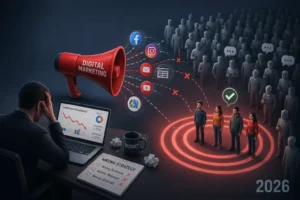
Why Your Digital Marketing Strategy Is Not Reaching the Right Audience in 2026

Why Your Digital Marketing Strategy Is Not Reaching the Right Audience in 2026 is an important question for businesses that invest time and money in online marketing but struggle to generate meaningful results. Getting thousands of impressions, website visits, or social media followers does not necessarily mean your marketing is reaching potential customers.
Digital marketing success depends on connecting the right message with the right people at the right time. However, unclear targeting, outdated customer information, irrelevant content, and poorly optimized advertising campaigns can prevent businesses from reaching people who are most likely to buy their products or services.
In 2026, customers interact with brands across search engines, social media platforms, websites, email, and AI-powered discovery tools. This makes understanding customer behaviour more important than simply increasing online visibility.
This article explains the common reasons digital marketing campaigns fail to reach the intended audience and provides practical strategies to improve targeting, engagement, and conversions.
Why Your Digital Marketing Strategy Is Not Reaching the Right Audience in 2026
A digital marketing strategy may fail because it focuses too much on generating traffic and too little on understanding customer needs. Even a well-designed campaign can produce poor results when its targeting, messaging, or platform selection does not match the intended audience.
Here are the most common reasons.
1. Your Target Audience Is Not Clearly Defined
One of the biggest digital marketing strategy mistakes is trying to reach everyone. A business that targets a broad audience without identifying specific customer needs may spend its budget reaching people who have little interest in its products or services.
For example, a company offering professional digital marketing training should identify whether it wants to reach college students, job seekers, business owners, or working professionals. Each group has different goals, concerns, and reasons for enrolling.
How to fix it: Develop a clear customer profile that includes:
-
Age range and geographical location, where relevant.
-
Interests, preferences, and online behaviour.
-
Problems your product or service solves.
-
Purchasing power and buying motivations.
-
Preferred platforms and content formats.
Detailed target audience analysis helps businesses create campaigns that are relevant to potential customers instead of relying on broad assumptions.
2. Your Content Does Not Match Customer Search Intent
Customers use different types of searches depending on what they need. Some are looking for information, while others are comparing products or preparing to make a purchase.
For example, someone searching for “what is digital marketing” probably needs educational content. Someone searching for “digital marketing course fees” may be comparing available courses before making a decision.
If your content does not match these intentions, visitors may leave without taking action.
How to fix it: Match your content to the customer’s stage of decision-making.
-
Awareness: Publish educational blogs, explainer videos, and informative social posts.
-
Consideration: Share comparisons, detailed guides, service explanations, and demonstrations.
-
Decision: Provide transparent pricing, relevant testimonials, FAQs, and clear enquiry options.
Understanding search intent helps businesses attract people who need the information or services they offer.
How Poor Audience Targeting Reduces Digital Marketing Results
Effective digital marketing audience targeting requires more than selecting a location, age group, or interest inside an advertising platform. It involves understanding what potential customers want and identifying the channels through which they are most likely to discover your business.
3. You Are Using the Wrong Marketing Channels
Not every platform is suitable for every business. A campaign may perform poorly simply because the intended audience does not actively use the selected channel for that particular purpose.
For example, a B2B software company may benefit from professional networking platforms, search advertising, and industry-specific content. A fashion retailer may achieve better engagement through visual social media content and shopping-related searches.
Choosing channels based only on popularity can waste marketing resources.
How to fix it: Evaluate platforms using these factors:
-
Where your potential customers spend time online.
-
Whether the platform supports your campaign objectives.
-
The type of content that performs well there.
-
The cost of acquiring a relevant visitor or lead.
-
The quality of enquiries and conversions generated.
Review performance regularly rather than assuming that every popular platform deserves an equal share of your budget.
4. Your Customer Segmentation Is Too Broad
Customer segmentation in digital marketing means dividing a larger audience into smaller groups based on shared characteristics, needs, behaviours, or purchasing patterns.
Without segmentation, businesses often send the same message to customers with different expectations.
For example, an online store selling home organization products could separate customers interested in bathroom storage, kitchen organizers, and wardrobe solutions. Each group can receive content and product recommendations that match its interests.
How to fix it: Create meaningful audience segments using available, appropriately collected data.
-
Demographic segmentation: age range or other relevant characteristics.
-
Geographic segmentation: city, region, or service area.
-
Behavioural segmentation: browsing activity or previous purchases.
-
Interest-based segmentation: topics or product categories customers engage with.
-
Lifecycle segmentation: new visitors, leads, existing customers, and returning buyers.
Useful segmentation improves message relevance and helps businesses use advertising budgets more efficiently.
The Role of Data, Personalization, and AI in Audience Targeting
Marketing decisions based on assumptions can lead to wasted spending. Businesses need reliable information about how people discover, interact with, and respond to their campaigns
5. You Are Ignoring Data and Campaign Performance
Data-driven marketing strategies help businesses understand which activities attract qualified visitors and which ones fail to produce meaningful outcomes.
For example, a campaign may generate a large number of clicks but very few enquiries. This could indicate that the advertisement attracts the wrong audience, the landing page does not meet expectations, or the offer is unclear.
Instead of increasing spending immediately, marketers should investigate the reason behind the performance.
Important metrics include:
-
Click-through rate (CTR): The proportion of impressions that result in clicks.
-
Conversion rate: The proportion of relevant visitors who complete a desired action.
-
Cost per lead (CPL): The amount spent to generate a lead.
-
Customer acquisition cost (CAC): The cost of acquiring a customer.
-
Engagement rate: How people interact with content, depending on the platform’s measurement method.
-
Lead quality: Whether enquiries match the business’s intended customer profile.
Use analytics tools, advertising reports, and CRM data where available. Ensure tracking is configured correctly and collected information is handled responsibly.
6. Your Campaigns Lack Personalization
Personalized digital marketing campaigns make content more relevant to different customer groups. When every customer receives the same message, the campaign may fail to address their specific problems or motivations.
For instance, a first-time website visitor may need an introductory guide, while a returning visitor may benefit from a detailed service explanation or product comparison.
Personalization does not always require advanced technology. Even adjusting headlines, offers, email content, and landing pages to suit different audience segments can improve relevance.
Best practices for personalization:
-
Use customer needs to guide messaging.
-
Recommend relevant content or products.
-
Customize landing pages for different campaign objectives.
-
Send emails based on appropriate preferences and interactions.
-
Respect privacy choices and applicable data protection requirements.
The goal is to make communication more useful, not to collect unnecessary personal information.
7. You Are Not Adapting to Digital Marketing Trends in 2026
Digital marketing trends in 2026 include the continued development of AI-assisted marketing, changing search experiences, privacy-conscious measurement, and increasingly personalized customer journeys.
Customers may discover businesses through traditional search results, social platforms, video content, online communities, and AI-generated answers. Depending on the industry, relying on only one channel can limit visibility.
Businesses should also recognize that AI tools cannot automatically correct a weak marketing strategy. Poor customer information, unclear positioning, and irrelevant content can still produce poor results even when automation is involved.
How to adapt:
-
Create helpful content that directly answers customer questions.
-
Maintain accurate and consistent business information online.
-
Optimize website content for traditional search and relevant AI discovery experiences.
-
Test AI tools for research, content planning, and campaign analysis.
-
Review results before making significant budget decisions.
The strongest approach combines technology with human judgment, reliable information, and a clear understanding of customer needs.
Practical Tips to Improve Digital Marketing Reach
Improving digital marketing reach is not simply about increasing impressions. It is about making your business visible to people who are genuinely interested in what you offer.
Follow these practical steps.
1. Audit Your Existing Campaigns
Review your current advertising, social media content, website traffic, and search performance. Identify which channels bring relevant visitors and which generate little meaningful engagement.
Check whether the campaign’s actual audience matches your intended customer profile.
2. Research Your Customers Regularly
Use customer feedback, enquiry forms, sales conversations, search queries, and website analytics to understand customer needs.
Avoid relying entirely on assumptions made when the campaign was first launched. Customer expectations can change, and your marketing strategy should adapt accordingly.
3. Improve Your Content Strategy
Create content around genuine customer questions and problems. Use relevant keywords naturally in headings, page titles, descriptions, and helpful body content.
Include clear examples, practical explanations, and appropriate calls to action. For local businesses, provide accurate location and service information where it helps customers make decisions.
4. Test Your Audience Targeting
Run controlled tests with different audience segments, messages, creative formats, or landing pages. Change one important variable at a time where practical so you can better understand what influences performance.
Evaluate results using lead quality and conversions, not just clicks or impressions.
5. Align Your Website With Your Campaigns
Your advertisement and landing page should communicate the same offer. If an advertisement promotes a particular service, visitors should be able to find relevant details quickly after clicking.
Improve page loading speed, mobile usability, navigation, trust signals, and the visibility of enquiry forms.
6. Review Results and Optimize Consistently
Set clear objectives and review performance at regular intervals. Identify which changes improve audience relevance and which fail to deliver useful outcomes.
There is no universal advertising budget, targeting setting, or posting frequency that guarantees success. The right approach depends on the business, its customers, its offer, and the quality of its execution.
Common Mistakes to Avoid When Targeting the Right Audience
Even businesses with an established digital presence can make avoidable mistakes that reduce campaign effectiveness.
-
Chasing vanity metrics: High impressions and follower counts do not necessarily indicate sales potential.
-
Using outdated audience assumptions: Customer preferences and online behaviour can change over time.
-
Copying competitors blindly: A strategy that works for another brand may not suit your audience or business objectives.
-
Ignoring mobile users: Poor mobile experiences can discourage visitors from exploring your services.
-
Using misleading advertisements: Promises that do not match the actual offer can damage trust and reduce conversions.
-
Neglecting follow-up: Relevant leads may lose interest when enquiries receive delayed or unclear responses.
-
Making decisions too quickly: Small samples or short testing periods can produce misleading conclusions.
-
Ignoring privacy and consent: Tracking and personalization should follow applicable rules and platform policies.
Avoiding these mistakes helps create a more sustainable marketing strategy built around customer needs, relevant communication, and measurable outcomes.
FAQs
1. Why is my digital marketing strategy not reaching the right audience in 2026?
Common reasons include unclear audience profiles, incorrect targeting, irrelevant content, unsuitable marketing channels, and weak campaign tracking. Reviewing customer data and matching content to customer needs can help identify the main problem.
2. How can I improve digital marketing audience targeting?
Define your ideal customer, analyze relevant customer behaviour, segment audiences by shared needs, select appropriate platforms, and test different messages. Measure lead quality and conversions to determine whether your targeting is effective.
3. What are the best audience targeting strategies for small businesses?
Small businesses can start by defining a specific customer group, targeting relevant locations when necessary, creating useful content, using focused advertising campaigns, and tracking enquiries. Prioritize channels that attract relevant prospects within the available budget.
4. How do data-driven marketing strategies improve conversion rates?
They help businesses identify which campaigns attract qualified visitors, where potential customers leave the buying journey, and which messages produce meaningful actions. These insights support better decisions about targeting, content, and spending.
5. How does AI affect digital marketing audience targeting in 2026?
AI can assist with audience research, content personalization, trend analysis, and campaign optimization. However, its recommendations depend on the quality of available information. Human review, responsible data use, and ongoing performance measurement remain essential.
For further reading on similar topics, check out article on: The Future of SEO: Writing Content That People Value
Facebook
Twitter
LinkedIn
Email

slashfordofficial
Reach Out to Us for Any Inquiries, Support, or Feedback!
Latest Post


16 October 2026

16 October 2026

16 October 2026

16 October 2026

Slashford is a leading digital marketing company that specializes in providing advanced and innovative solutions to businesses of all sizes and industries.